Three Levels of SaaS Automation: Guardrails, Operations, and Agents
Not every task needs an autonomous agent. A cleaner model: three levels of automation organized by who decides what happens next — the system, the human, or the agent.
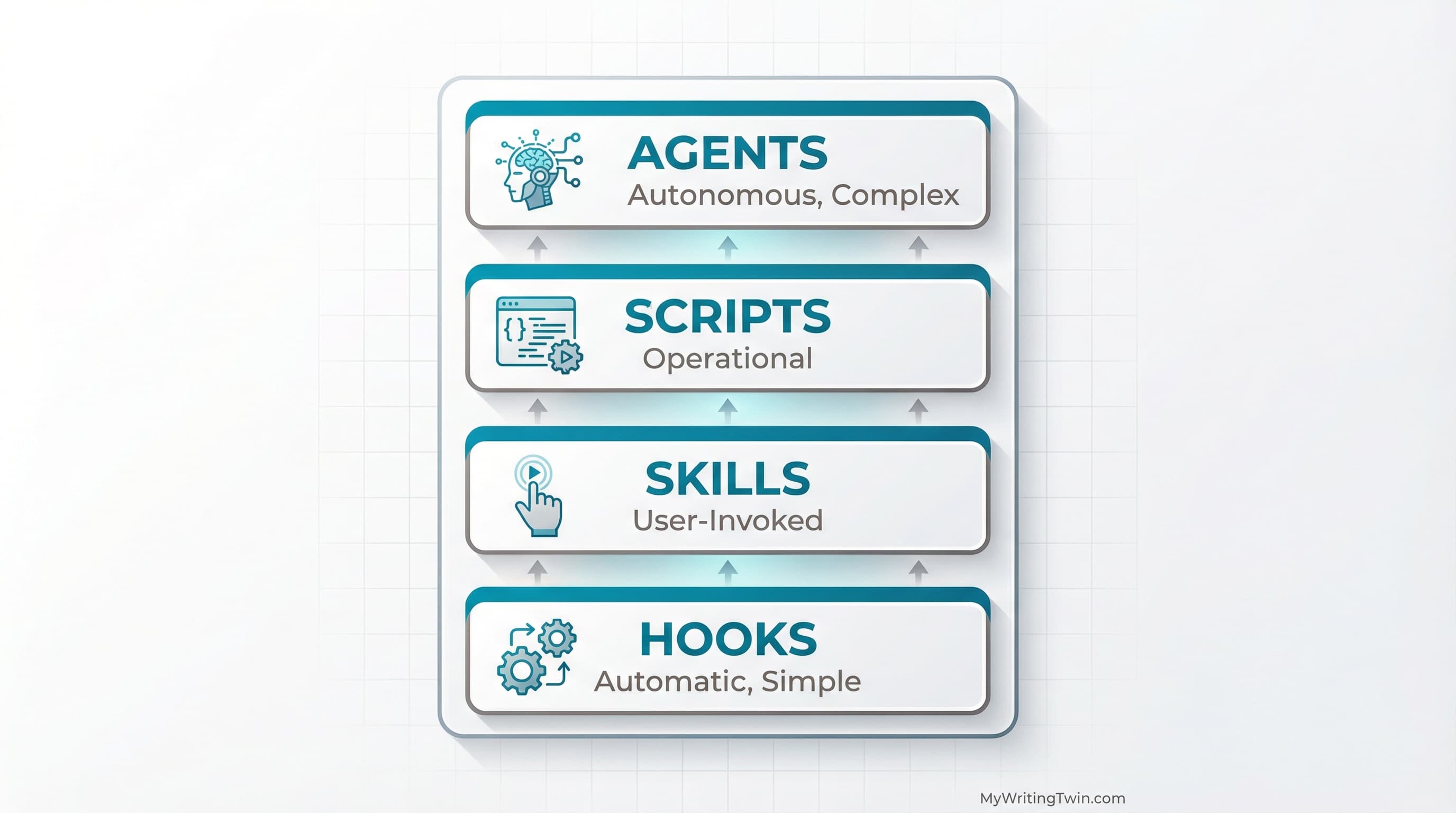
Most automation taxonomies fail because they categorize by implementation mechanism — scripts vs. AI calls, deterministic vs. probabilistic, simple vs. complex. These distinctions sound clean on paper but collapse in practice. The script that calls an API to classify text. The "AI skill" that's 90% deterministic data fetching with one LLM call at the end. The agent that mostly runs scripts in sequence.
A better organizing principle: who decides what happens next?
That question cuts through the implementation noise and reveals three genuinely distinct levels of automation. Each level has a different relationship between the human and the system. Each serves a different kind of problem. And matching tasks to the wrong level wastes either time or reliability — often both.
This is how MyWritingTwin.com runs its entire operation with three levels of automation and 7 standing agents — and why the organizing principle matters more than the specific tools.
The Three Levels
Level 1: Guardrails — The System Decides
Guardrails run without human invocation. They enforce constraints that should never be violated — automatically, silently, on every relevant event.
Who decides? The system. No human judgment involved. A guardrail either passes or blocks. Binary. Deterministic. Zero tokens spent.
What they look like in practice:
MyWritingTwin maintains 5 git hooks that prevent entire categories of failure:
- Translation sync validation. Every UI string in
messages/en.jsonmust have a corresponding key across all four locales. If a key is missing, the commit is rejected. Error rate for translation sync issues went from "occasional but embarrassing" to zero. - Frontmatter validation. Every blog post requires specific metadata — title, description, date, tags. Missing any of these breaks the sitemap, RSS feed, or SEO metadata. The hook catches it before the file reaches the repository.
- Post-merge consistency. After pulling changes, hooks verify that the local environment matches the updated codebase — dependencies, generated files, configuration.
When to use guardrails:
Three criteria, all must apply:
- Binary outcome. Pass or fail. No gray area.
- High frequency. The triggering event happens often — every commit, every deploy.
- Catastrophic if missed. The failure costs more than the friction of the check.
If a task requires interpretation, context awareness, or judgment of any kind — it's not a guardrail. It belongs at a higher level.
Level 2: Operations — The Human Decides
Operations are the daily workhorse. A human decides when to invoke them. The system handles the execution. One command in, one structured result out.
Who decides? The human. You choose the moment, the context, and the parameters. The system executes the workflow.
What they look like in practice:
The MyWritingTwin ecosystem contains over 90 defined operational capabilities — from single-purpose utilities to multi-step research workflows. In daily use, about 20 are invoked regularly. Here are three that illustrate the range:
Content briefing. Input: a blog topic and target keyword. The operation reads internal documentation, scans 161 existing blog posts for overlap, pulls positioning guidelines from brand voice docs, checks terminology rules, identifies internal linking opportunities, and returns a structured brief. What takes 30-60 minutes manually happens in seconds.
Competitive research. Input: a competitor URL. The operation analyzes positioning, pricing, feature set, content strategy, and identifies gaps. Returns a structured analysis with specific recommendations.
Quality checks. A suite of validation operations — TypeScript type checking, test suite execution, build verification, translation integrity, SEO audits. Each runs a defined procedure, produces a predictable report.
Anatomy of an Operation
This is where most automation taxonomies go wrong. They try to separate "scripts" (deterministic) from "skills" (AI-powered) as distinct layers. In reality, almost every useful operation is a hybrid:
Take the content briefing operation. Here's what actually happens inside:
- Read brand voice config — deterministic file read
- Scan existing posts for keyword overlap — deterministic search + fuzzy matching
- Fetch SEO keyword data — deterministic API call
- Check terminology rules — deterministic pattern matching
- Synthesize findings into a structured brief — LLM reasoning
- Validate output format — deterministic schema check
Six steps. Five are deterministic scripts. One is an LLM call. Calling this an "AI skill" overstates the AI involvement. Calling it a "script" understates it. It's an operation — a hybrid workflow where deterministic steps do the heavy lifting and AI reasoning handles the synthesis that humans would otherwise do manually.
This pattern holds across the entire system. The typical operation is 80% deterministic plumbing (fetch data, validate inputs, format outputs) and 20% LLM reasoning (synthesize, classify, generate). The AI isn't the operation — it's one step inside it.
Understanding this matters because it changes how you build automation. You don't need to "make everything AI-powered." You need to identify the 20% where human judgment is the bottleneck and insert an LLM call there. The rest should be reliable, fast, deterministic code.
When to use operations:
A useful heuristic: if a manual task takes 5-60 minutes and follows a repeatable pattern, it's an operation candidate. Below 5 minutes, a guardrail or a quick script might suffice. Above 60 minutes with multiple decision points, you might need an agent.
Level 3: Agents — The Agent Decides
Agents are the most capable level — and should be used least often. An agent takes a goal, not a procedure. It plans the steps, executes them, makes decisions at each stage, and delivers a finished result for review.
Who decides? The agent. Within defined constraints, the agent determines what to do next. The human reviews the output, not the process.
What they look like in practice:
MyWritingTwin runs 7 standing agents. Each handles a distinct autonomous workflow:
| Agent | Function | Key Metric |
|---|---|---|
| Content Pipeline | End-to-end blog post production across 4 languages | 161 posts published |
| Quality Gate | 7 validation checks before every deploy | 930+ tests, ~5 min |
| Daily Briefing | Aggregates PostHog, GSC, Stripe, YouTube, Anthropic data | 5 dashboards → 1 report |
| User Lifecycle | Monitors customer journey, detects stuck users, drafts interventions | Proactive vs. reactive |
| SEO Monitor | Weekly keyword tracking, position changes, content gaps | Continuous optimization |
| AEO Infrastructure | AI Engine Optimization — visibility across ChatGPT, Perplexity, Gemini | AI referral tracking |
| Product Bootstrap | Scaffolds new SaaS products from template | 45-55 files per product |
The Content Pipeline agent illustrates the distinction from operations. An operation runs one step. The Content Pipeline chains nine steps with decision-making between them: generate a briefing, check for overlap (and adjust the angle if overlap exists), write with brand rules, generate a hero image, verify SEO elements, create social distribution drafts, and produce a quality report. The right action at step 4 depends on what happened at step 2.
When to use agents:
Use an agent when the task requires genuine decision-making at multiple points during execution. If the task can be fully specified in advance — all inputs known, all steps predetermined — it's an operation, not an agent.
The cost difference is real. Agents are slower, consume more resources, and can make wrong decisions that need correction. These tradeoffs are worth it when the alternative is a human spending hours orchestrating a multi-step workflow. They're not worth it when a deterministic operation would produce the same result.
Matching Tasks to Levels
The decision framework is simple:
| Question | If Yes → | If No → |
|---|---|---|
| Should this constraint be enforced automatically on every event? | Guardrail | ↓ |
| Can the task be fully defined as a repeatable workflow with known inputs/outputs? | Operation | ↓ |
| Does it require multi-step planning with decisions that depend on intermediate results? | Agent | Reconsider if automation is needed |
A common evolution: tasks start as manual processes, get automated as operations once the procedure stabilizes, and some get promoted to agents when branching logic and decision-making requirements emerge. The translation sync started as a manual checklist, became an operation, and the validation piece became a guardrail.
Build from the bottom up. Guardrails first. Then operations. Agents only when lower levels can't handle the complexity.
The Economics
All three levels run on flat-rate subscriptions — no per-operation API costs for internal use.
- Guardrails: Zero cost. Local execution, no external calls.
- Operations: Zero marginal cost via Claude Max subscription ($200/month covers unlimited invocations).
- Agents: Same flat-rate subscription. Customer-facing operations (like Style Profile generation) use separate API billing that's self-funded by customer payments.
The flat rate removes the "should I automate this?" cost calculation. The only question is whether the task matches the right level.
See Systematic AI Analysis in Practice
Curious what this kind of structured, methodical AI analysis looks like applied to something personal? Try the free Writing DNA Snapshot — no credit card required. See how your writing patterns map across 20+ style dimensions, and discover what makes your communication style distinctly yours. It works with ChatGPT, Claude, Gemini — any AI.